The short answer: yes, in most industrial and high-occupancy buildings
Cables are everywhere in a modern plant or building, and that is exactly why they are dangerous in a fire. A single cable tray can carry hundreds of kilograms of PVC, rubber and polymer sheathing. Stacked trays in a cable gallery, shaft or riser can hold tons of it. Once ignited, that material burns, spreads flame along the tray, and carries the fire from one room, floor or building section to the next.
So do cable trays and cable runs need fire protection coatings? Not every short run of wiring in a small office does. But in power plants, substations, refineries, data centers, hospitals, metro systems, high-rise risers and any facility with dense, bunched cabling, fire protection of cable runs is a core part of passive fire protection, and it is something Indian standards and project specifications ask for.
This guide explains why, what the standards say, and how coatings and firestopping work together.
Why cable runs are a serious fire risk
1. They are a hidden fuel load. Cable insulation and sheathing are combustible. When cables are bunched on trays, the fuel load is concentrated and continuous, often running the full length of a building.
2. They spread fire along their length. A burning tray works like a fuse. Flames travel horizontally along the run and climb vertical risers quickly, because a vertical shaft behaves like a chimney.
3. They breach fire compartments. Every place a cable passes through a wall or floor is a hole in a fire-rated barrier. If that opening is not sealed with a tested firestop, fire and smoke pass straight through, and the compartment's rating is lost.
4. They produce toxic, corrosive smoke. Burning PVC gives off dense smoke and hydrochloric acid gas. The smoke threatens people trying to escape, and the acid gas corrodes switchgear, control panels and electronics well away from the fire itself. The repair bill after a cable fire is often far larger than the fire damage.
5. They carry the circuits you need most. Control cables, fire alarm circuits, emergency lighting and safe shutdown systems often share routes with power cables. Lose the cable route and you can lose control of the plant at the worst possible moment.
This is not a theoretical concern. Regulators of high-hazard industries, such as the US Nuclear Regulatory Commission, have long required fire barriers or fire-retardant coatings on cabling to protect essential safety systems, and test programs sponsored by the NRC have found that fire-retardant coatings can substantially delay cable heating, ignition and electrical failure under fire conditions.
What the Indian standards say
The key Indian reference is IS 12459, the Code of Practice for Fire Safety in Cable Runs, published by the Bureau of Indian Standards. Its aim is to stop fire spreading along cable routes and to maintain circuit integrity during a fire. It covers cable trays, trenches, vaults, tunnels and risers, and the measures it addresses include fire-retardant coatings, fire stops, intumescent seals and mineral wool barriers.
A few points every specifier and facility owner should know:
- Fire barriers at intervals. Like comparable international codes, IS 12459 calls for fire barriers or stops in long horizontal runs and at vertical risers, so that a fire cannot travel the full length of a route.
- Two-hour separation. Barriers, partitions and fire stops separating cable runs should generally have a fire resistance of not less than two hours.
- Special attention to tunnels and vaults. Cable tunnels and vaults carry the highest fuel loads and get their own requirements, along with ventilation and fire detection.
- The standard is being updated. BIS approved a first revision of the code, IS 12459:2024, so project specifications are increasingly being written to the newer edition.
The National Building Code of India (NBC 2016, Part 4) also requires that openings for services through fire-rated walls and floors are sealed so that the fire rating of the element is maintained. And many owners in power, oil & gas and infrastructure write cable fire protection directly into their technical specifications.
Fire retardant coatings vs. firestopping: you usually need both
The two systems solve different problems.
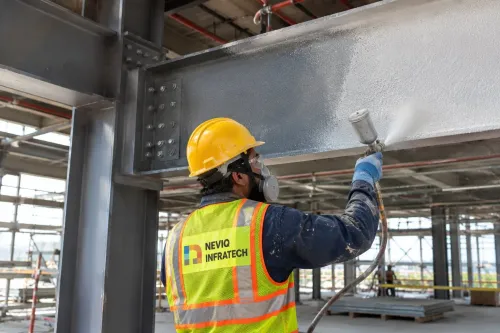
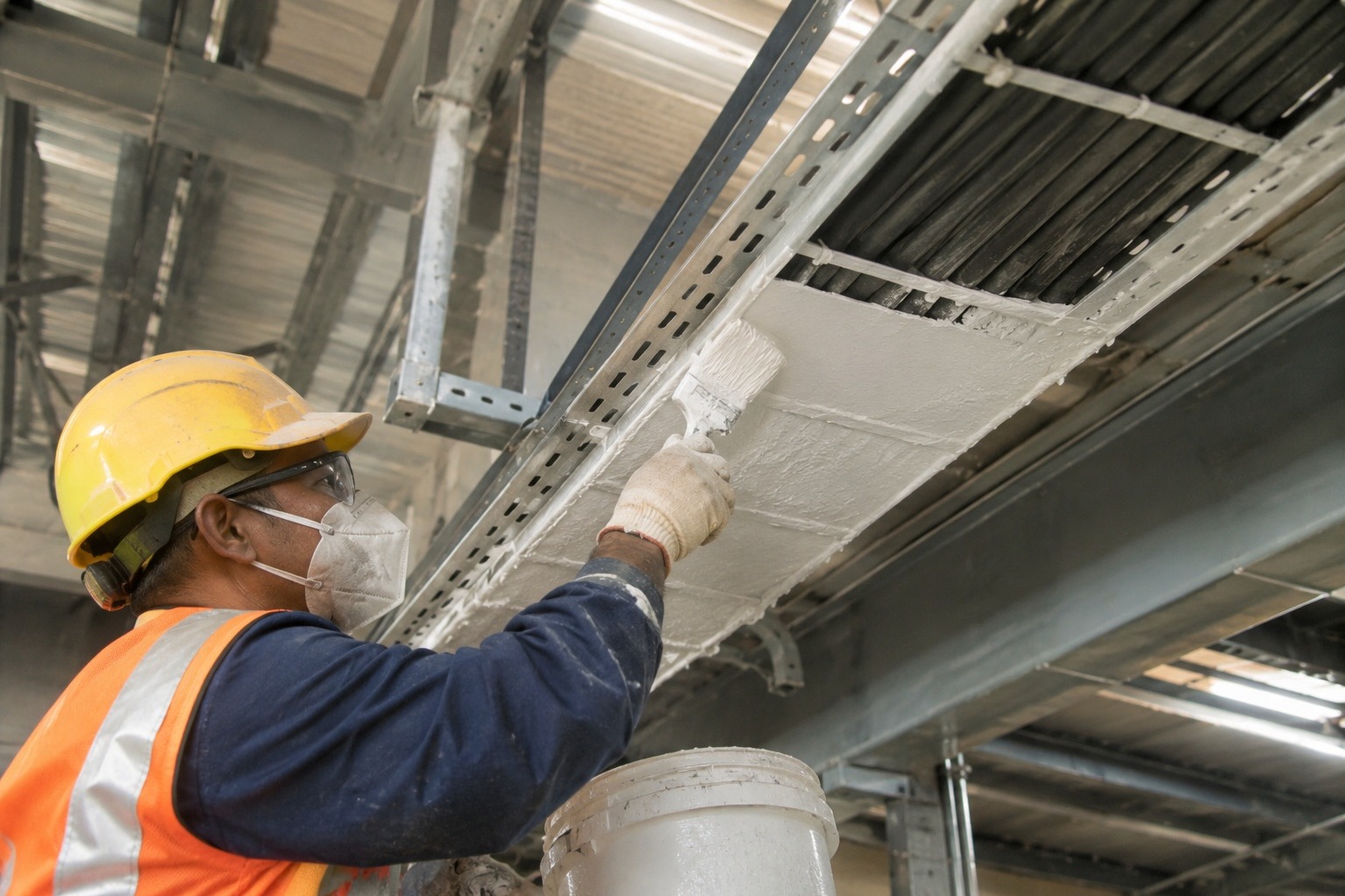
Fire retardant cable coatings are applied directly to cables and trays. They slow ignition and stop flame spreading along the run. Typical specifications call for:
- A water-based, flexible coating compatible with PVC, FRLS, XLPE, neoprene and silicone rubber sheathing
- A specified dry film thickness, commonly around 1.6 mm
- Coating along the full run, or in bands at regular intervals, with extra coverage on both sides of cable joints, crossings and penetrations
- Low impact on cable ampacity, so cables do not need to be significantly derated
Firestopping seals the openings where cables pass through fire-rated walls and floors. It keeps each fire compartment intact. Typical systems include:
- Coated mineral wool boards (ablative batt systems) for large tray openings
- Intumescent sealants, putties, pillows and foams for smaller or frequently modified penetrations
- Fire-rated collars and wraps for conduits and plastic pipes running alongside cables
Coatings without firestops leave the compartment walls open. Firestops without coatings leave long runs free to burn between walls. A well-designed system uses both, matched to the layout of the cable routes.
Where cable fire protection matters most
- Thermal, hydro and renewable power plants, and substations
- Refineries, petrochemical plants and chemical process units
- Steel, cement and heavy manufacturing plants
- Data centers and telecom facilities
- Hospitals and healthcare buildings
- Metro rail, airports, tunnels and ports
- High-rise commercial and residential towers (electrical shafts and risers)
- Cable galleries, cable spreading rooms, trenches and vaults in any facility
How NEVIQ Infratech protects your cable runs
NEVIQ Infratech Pvt. Ltd. has specialized in passive fire protection since 2018. We focus on fireproofing and firestopping, and we take responsibility for the whole job, from design to handover.
One partner, start to finish. We handle passive fireproofing design consultancy, material supply, installation and quality checks. You don't need to coordinate a separate designer, supplier and applicator.
NACE-certified specialists. Our team of NACE-certified professionals oversees design, surface preparation, application and inspection, so coatings are applied to the right thickness and perform as tested.
EPC packages for fire penetration sealing. We deliver complete fire penetration sealing packages for cable and service penetrations through walls and floors, covering survey, system selection, installation and documentation.
A complete cable fire protection range. Our portfolio includes fire retardant coating compounds for cables and trays, fire sealing and barrier systems for penetrations, and structural fireproofing systems for the steel that supports your cable racks.
Fireproofing beyond cables. Cable protection is rarely a standalone need. We also provide cementitious and vermiculite fireproofing, gypsum-based architectural fireproofing, water- and solvent-based intumescent coatings for cellulosic fires, and hydrocarbon pool fire intumescent fireproofing for oil, gas and process plants. One contractor can protect your structure, your cable routes and your compartment walls together.
Cost-effective procurement. Our end-to-end model includes project management and efficient procurement, which helps keep projects on budget without compromising on tested materials.
Protect your cable runs before a fire tests them
Cable fires spread fast, generate toxic smoke and can shut down a facility for weeks. The right combination of fire retardant coatings and firestopping keeps a fire where it starts and keeps critical circuits running.
Talk to NEVIQ Infratech for a site survey, a cable fire protection design, or a complete EPC package for coatings and penetration sealing.
Keywords