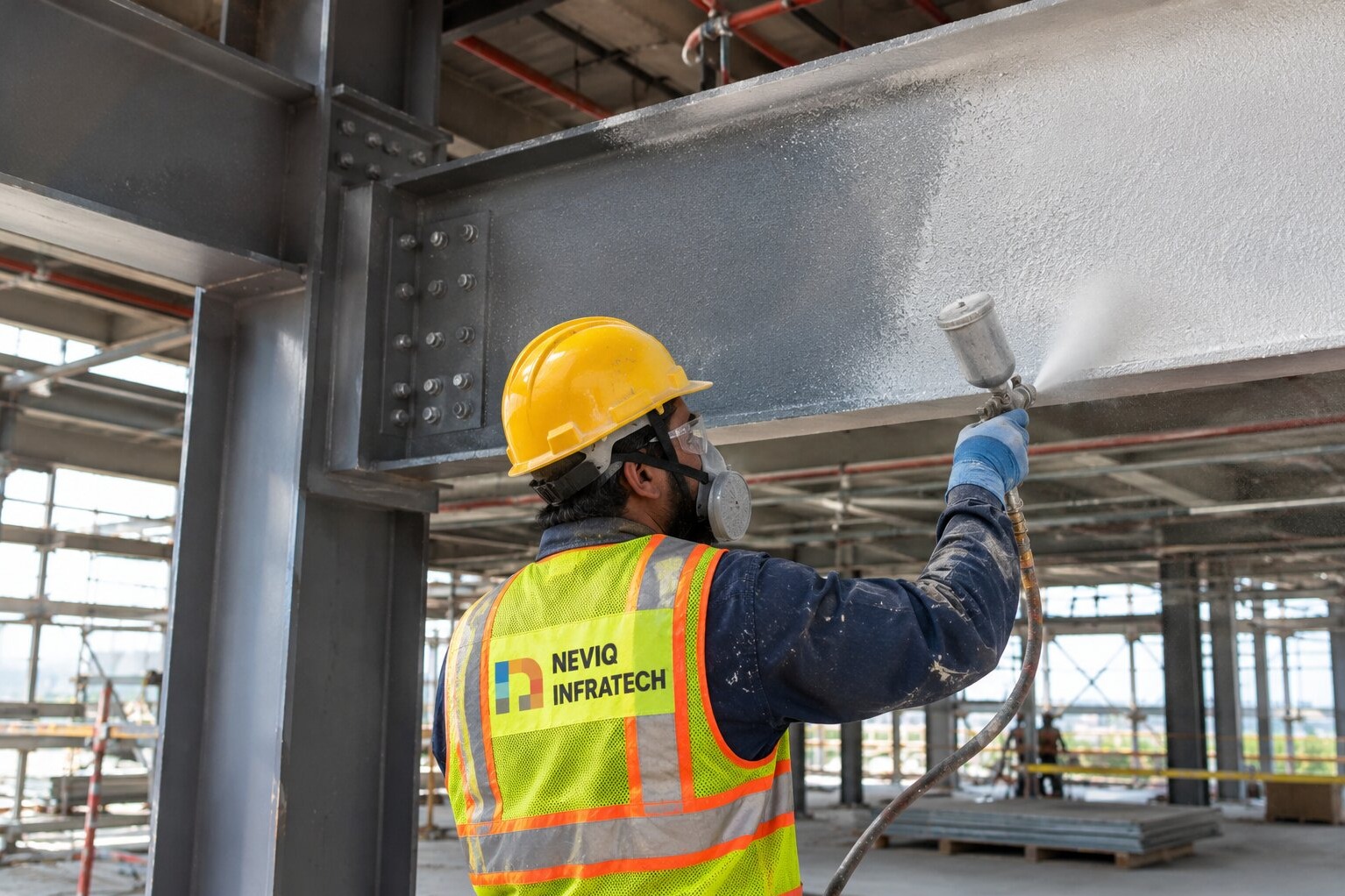
Intumescent paint is an essential component of passive fire protection for structural steel. In normal conditions, it appears as a specialist coating applied over steel members. During a fire, heat causes the coating to expand and form an insulating char layer. This layer helps slow the rate at which steel heats up, helping it retain its load-bearing capacity for the specified fire-resistance period.
Like any protective system, intumescent paint can be damaged over time. Site activity, impact, moisture, corrosion, later modifications and poor maintenance can all affect its condition. Repairing this damage correctly is important because intumescent paint is not an ordinary decorative coating. It is part of a tested fire protection system and should be repaired using an approved, compatible method.
NEVIQ INFRATECH provides professional intumescent paint inspection, repair and passive fire protection services for commercial, industrial and infrastructure projects.
Why damaged Intumescent Paint needs immediate attention
Damage to intumescent paint can expose structural steel to the environment and reduce the continuity of fire protection. If left untreated, small chips and cracks may allow moisture to reach the steel surface, leading to corrosion beneath the coating.
Where corrosion develops, the coating may lose adhesion, blister or delaminate. In a fire, damaged or incorrectly repaired areas may not perform as intended. Timely inspection and repair help preserve both the durability of the steelwork and the integrity of the fire protection system.
Common types of Intumescent Paint damage
Intumescent coatings can be affected by several forms of damage, including:
- Scratches, chips and gouges caused by impact
- Cracking, flaking or peeling of the coating
- Abrasion caused by maintenance work or equipment movement
- Damage around bolts, connections, brackets and service penetrations
- Water staining, moisture exposure or condensation
- Corrosion forming beneath the coating
- Blistering or loss of adhesion
- Incomplete, uneven or insufficient coating thickness
- Damage caused by installation of cables, pipes, ducts or other services
- Ageing caused by weather, UV exposure or harsh environments
Every damaged area should be assessed before repair. A small local touch-up may be appropriate in some situations, while widespread delamination, corrosion or coating failure may require a more extensive repair programme.
Step 1: Identify the original fire protection system
Before starting any repair, it is important to identify the existing intumescent paint system wherever possible. The original coating manufacturer, primer, intumescent product, topcoat and specified fire rating should be checked against available project records.
This information helps determine:
- The required fire-resistance period
- The correct compatible repair materials
- The required coating thickness
- The appropriate surface-preparation method
- Whether a primer or topcoat needs to be reinstated
- Applicable drying, curing and recoating times
If the existing system cannot be identified, a passive fire protection specialist should review the condition of the coating and recommend a suitable approved repair solution.
Step 2: Inspect the extent of the damage
A professional inspection should establish whether the damage is only on the surface or extends through the coating to the steel substrate. The inspection should consider:
- Location and size of damaged areas
- Whether the coating is firmly bonded around the damage
- Presence of rust, corrosion or moisture
- Existing dry film thickness
- Condition of nearby coating
- Fire rating required for the steel member
- Accessibility and exposure conditions
- Any changes made to the steelwork or surrounding services
Thickness measurements are especially important. Intumescent coatings are specified according to the steel member, its section factor and the required fire rating. A repair must restore the appropriate dry film thickness—not simply cover the visible defect.
Step 3: Isolate and protect the work area
Before repair work begins, the affected area should be safely accessed and protected. Nearby finished surfaces, services and unaffected steelwork should be covered to prevent overspray, dust or accidental damage.
Where repair work is being performed in an occupied building, the team should also consider dust control, access restrictions, ventilation, sequencing and the impact on normal operations.
NEVIQ INFRATECH plans intumescent paint repair works around project requirements, site safety procedures and operational constraints.
Step 4: Remove loose, cracked or defective coating
Damaged intumescent paint should be carefully removed back to a sound, firmly bonded edge. Loose, cracked, blistered or delaminated areas should not be painted over, as this can trap defects beneath the new coating.
The surrounding intact coating is feathered to provide a smooth transition between the existing coating and the repair area. Care must be taken not to cause unnecessary damage to sound adjacent coating.
If the coating failure is widespread, the repair area may need to be extended until a stable, properly adhered surface is reached.
Step 5: Treat corrosion and prepare the steel surface
If the steel substrate is exposed or corrosion is found beneath the coating, the steel must be cleaned and prepared before the intumescent paint is reinstated.
Typical preparation may include:
- Removing dust, dirt, oil, salts and other contaminants
- Removing rust and loose corrosion products
- Mechanical or abrasive preparation, where specified
- Ensuring the steel is dry and free from moisture
- Preparing the surface to the required project or manufacturer standard
Where required, a compatible anti-corrosive primer is applied to the prepared steel. The primer must be approved for use with the selected intumescent paint system and allowed to cure before further coating application.
Step 6: Reinstate the Intumescent Paint
Once the substrate is properly prepared, the approved intumescent coating can be reapplied. Depending on the product, access conditions and repair scope, application may be carried out by brush, roller or spray.
The coating is applied in controlled coats to achieve the required thickness. Each coat must comply with the manufacturer’s recommendations for maximum application thickness, drying time and recoating interval.
The aim is to restore a continuous protective layer that matches the specified dry film thickness for the steel member. Attention should be paid to edges, corners, connections and complex steel profiles, as these areas can be more difficult to coat evenly.
Step 7: Reapply the protective topcoat
Many intumescent coating systems include a topcoat to protect the fireproofing from moisture, dirt, abrasion, chemicals or UV exposure. If the original system included a topcoat, it should be reinstated after the intumescent coating has fully cured.
The topcoat must be compatible with the intumescent product. Using an unapproved topcoat can affect the durability and, in some cases, the performance of the fire protection system.For external steelwork or high-wear environments, the correct protective topcoat is particularly important.
Step 8: Measure coating thickness and carry Out final inspection
Following application, the repaired areas should be checked for quality and conformity. A final inspection may include:
- Visual checks for cracking, pinholes, runs or missed areas
- Confirmation that repaired edges are smooth and well bonded
- Dry film thickness measurements
- Verification that required details, corners and connections are protected
- Checks that primer, intumescent coating and topcoat are compatible
- Photographic records of the completed repair
- Repair reports and inspection documentation
Can You touch up Intumescent Paint yourself?
Minor damage should not automatically be treated as a simple paint touch-up. The correct approach depends on the approved coating system, fire rating, coating thickness and condition of the steel beneath the damage.
A competent contractor may be able to complete small local repairs where the original system is known and the steel is free from corrosion. However, larger damaged areas, unknown coating systems, cracks, widespread peeling or exposed steel should be assessed by a specialist passive fire protection contractor.
Common mistakes to avoid during Intumescent Paint repair
Incorrect repair practices can compromise the long-term performance of intumescent paint. Common mistakes include:
- Painting over loose, cracked or blistered material
- Failing to remove corrosion before recoating
- Applying an incompatible primer, paint or topcoat
- Applying too little coating thickness
- Applying excessive thickness in a single coat
- Ignoring required drying and curing times
- Repairing only visible damage without checking adjacent areas
- Failing to maintain inspection and thickness records
- Treating fireproofing as a standard decorative painting job
Using a qualified passive fire protection team helps avoid these issues and provides a more dependable repair outcome.
When should Intumescent Paint Be repaired or replaced?
Local repair may be suitable when damage is limited, the existing coating remains well bonded and the original system can be identified. More extensive remediation may be required if there is widespread cracking, corrosion, water damage, delamination or uncertainty about the original specification.
A detailed condition survey is the best way to determine whether local repair, partial replacement or full recoating is appropriate.
Intumescent Paint maintenance tips
Regular inspection can help identify problems before they become costly. Building owners, facility managers and project teams should consider periodic checks for:
- Mechanical damage after maintenance works
- New services fixed to protected steelwork
- Moisture leaks or condensation
- Rust stains or corrosion
- Cracks, chips, peeling or blistering
- Damaged topcoat finishes
- Unauthorized drilling, welding or alterations
Any repair work affecting protected structural steel should be recorded as part of the building’s fire safety and maintenance documentation.
Why Choose NEVIQ INFRATECH?
NEVIQ INFRATECH delivers specialist passive fire protection solutions with a focus on quality, compatibility and compliance. Our approach to intumescent paint repair includes careful assessment, proper surface preparation, approved coating application, thickness verification and clear documentation.
Our services include:
- Intumescent paint inspection and condition surveys
- Localized and large-area coating repairs
- Surface preparation and corrosion treatment
- Application of compatible primers, intumescent coatings and topcoats
- Dry film thickness checks and quality inspections
- Passive fire protection maintenance support
- Fireproofing solutions for structural steel
Contact NEVIQ INFRATECH for Intumescent Paint repair
Damaged intumescent paint should be assessed and repaired before it affects the performance of your passive fire protection system. NEVIQ INFRATECH provides dependable inspection, repair and maintenance solutions for structural steel fireproofing.
Contact our team to discuss your intumescent paint repair, fireproofing inspection or passive fire protection maintenance requirements.
Keywords