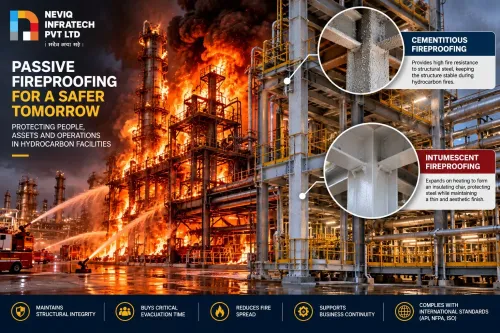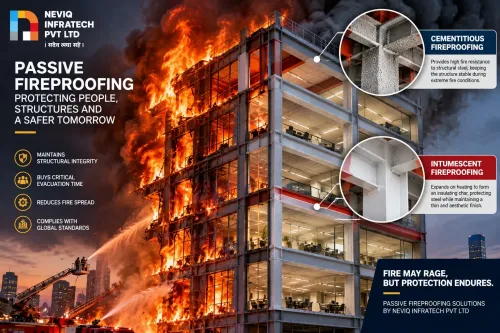
Passive fireproofing (PFP) is a critical safety investment for industrial plants, commercial buildings, warehouses, power projects, oil & gas facilities, and infrastructure assets. It protects structural steel, concrete, cable trays, and process equipment from high temperatures during a fire, helping them retain integrity for the specified duration.
For project owners, EPC contractors, and facility managers, the cost of passive fireproofing in India is not only determined by a single per-square-meter rate. The final price also depends on the fire-protection system, project conditions, safety requirements, and quality-control scope.
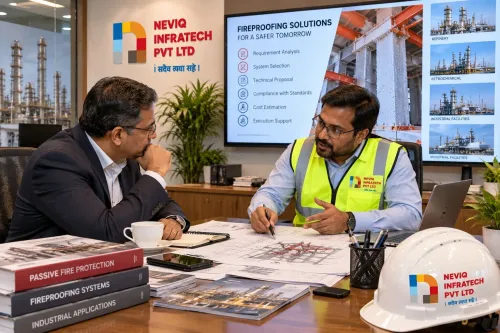
At NEVIQ INFRATECH, we assess the complete project requirement before proposing a passive fireproofing solution. The following factors have a direct impact on cost.
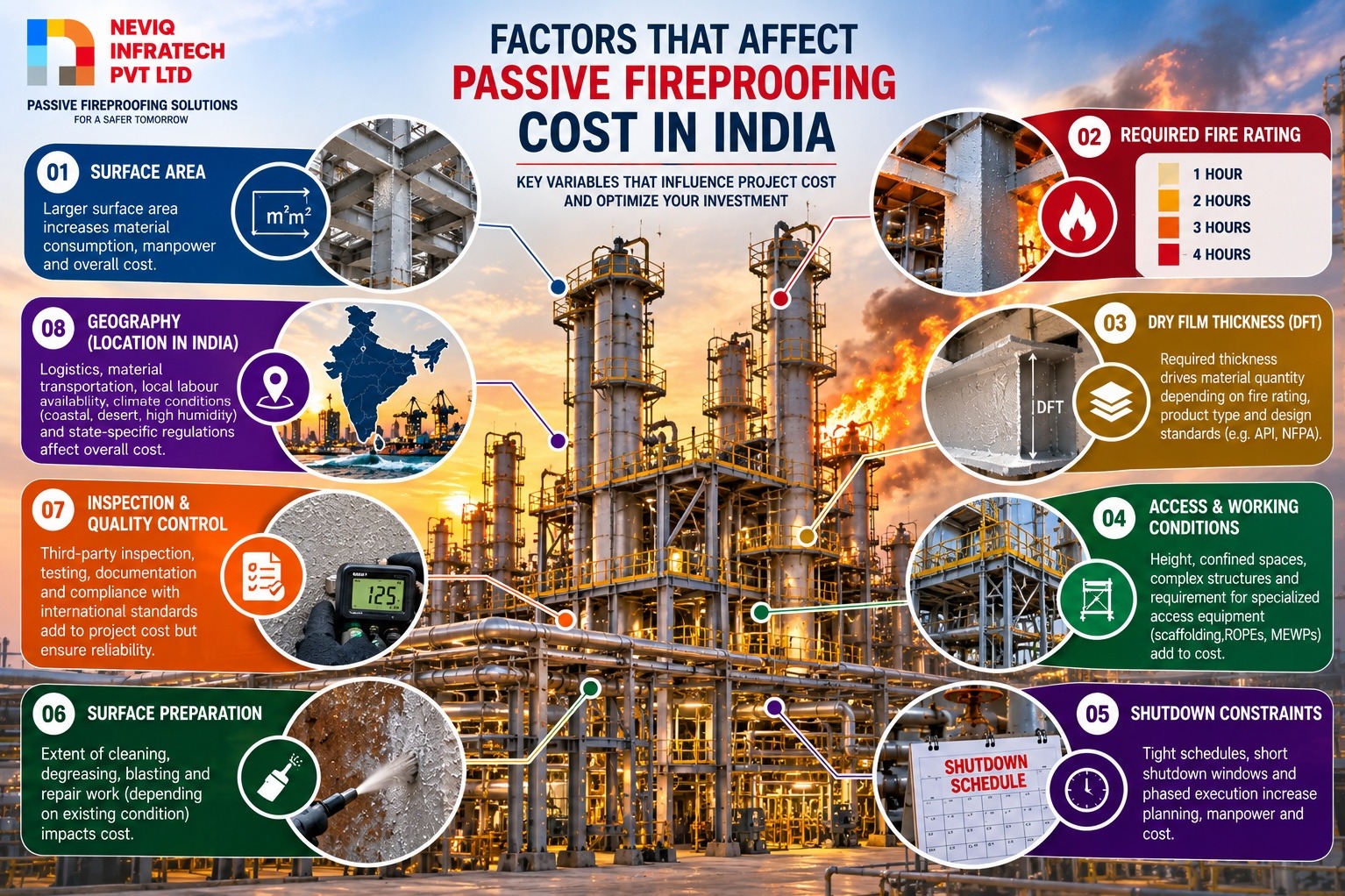
1. Surface Area and Quantity of Work
Surface area is one of the primary cost drivers. A larger steel or concrete area generally requires more fireproofing material, labor, equipment, and inspection effort.
However, higher quantities may reduce the unit rate because mobilization, site setup, and equipment costs can be spread across a larger work volume. Small or fragmented work packages often have a higher per-square-meter cost due to repeated mobilization and lower productivity.
The shape of the structure also matters. Simple beams, columns, and flat surfaces are faster to coat than complex connections, bracing members, pipes, supports, and congested areas.
2. Required Fire Rating
The required fire-resistance rating has a major influence on passive fireproofing cost. Common requirements may range from 60 minutes to 240 minutes or more, depending on the asset, occupancy, process hazard, and applicable fire-safety standard.
A higher rating usually requires:
- Greater material thickness
- More application time
- Additional coats or layers
- More stringent quality checks
- Higher material consumption
For example, a 120-minute fire rating will normally require less material and labour than a 240-minute rating for the same structural member. The fire-rating requirement should therefore be clearly defined at the design stage to avoid variation costs later.
3. Dry Film Thickness (DFT)
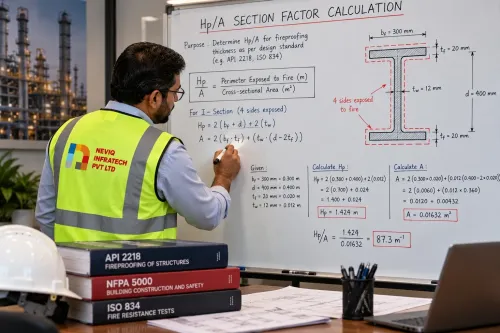
Dry Film Thickness, or DFT, is especially important for intumescent coatings and certain fireproofing systems. The required DFT is calculated based on the steel section factor, critical steel temperature, fire rating, and approved fire-test data.
Higher DFT increases the cost because it requires more coating material and may involve multiple application coats. It can also increase drying and curing time, which affects the project schedule.
DFT must be achieved uniformly across the protected surface. Under-application can compromise fire performance, while excessive thickness can lead to material wastage, sagging, cracking, or rework. Accurate DFT planning and measurement are essential for both safety and cost control.
4. Type of Passive Fireproofing System
The selected PFP system has a significant effect on the overall budget.
Common systems include:
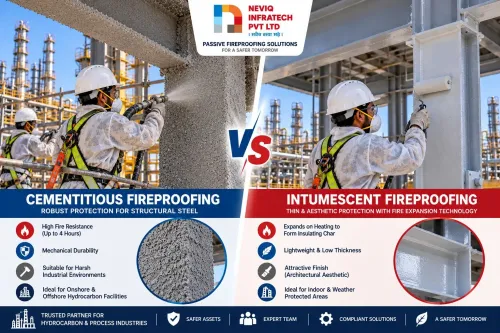
- Intumescent fireproof coatings
- Cementitious fireproofing sprays
- Vermiculite-based fireproofing
- Fireproof boards and encasement systems
- Epoxy intumescent coatings for hydrocarbon-fire exposure
Each system differs in material cost, thickness, surface-preparation needs, application method, durability, finish quality, and maintenance requirement.
For instance, intumescent coatings may have a higher material cost but provide a thinner, smoother, and more architectural finish. Cementitious spray-applied systems can be cost-effective for large industrial steel structures, while epoxy intumescent systems are commonly selected for demanding offshore, petrochemical, and hydrocarbon-risk environments.
The right choice should be based on fire exposure, environment, service life, appearance, and total lifecycle cost—not only the initial application rate.
5. Access Conditions and Working Height
Access is often a major hidden cost in passive fireproofing projects. Work at height, inside confined spaces, around operating equipment, or in congested plant areas requires additional planning and resources.
Costs may increase when the project requires:
- Scaffolding
- Boom lifts or man lifts
- Rope access
- Suspended platforms
- Temporary access structures
- Fall-protection systems
- Safety supervision
A structure that is easy to reach at ground level can be completed much faster than one located at significant height or within a tightly packed industrial unit. Early coordination of access planning helps prevent delays and unexpected cost escalation.
6. Shutdown and Operating Constraints
Many passive fireproofing works are executed in running plants, refineries, power stations, chemical facilities, and manufacturing units. In such cases, work may need to be carried out during a planned shutdown, turnaround, night shift, or restricted maintenance window.
Shutdown constraints can affect the price because they may require:
- Additional manpower and shifts
- Accelerated work schedules
- Fast-curing materials
- Continuous supervision
- Strict permit-to-work compliance
- Higher safety and coordination requirements
If the shutdown window is short, the contractor may need to mobilize more crews and equipment to finish the work on time. This can increase the project cost, but it helps reduce operational downtime.
7. Surface Preparation Requirements
The condition of the substrate strongly affects passive fireproofing cost. Before application, the surface may require cleaning, degreasing, rust removal, blasting, repair, primer application, or removal of old failed coatings.
Poor surface condition can lead to adhesion failure, corrosion beneath the fireproofing system, and premature coating damage. Surface preparation requirements are often influenced by the selected fireproofing material and the project specification.
The cost can increase when there is:
- Corrosion or pitting on structural steel
- Existing coatings that must be removed
- Oil, dust, grease, or chemical contamination
- Weld spatter and sharp edges
- Damaged primer or incompatible coating systems
- High surface-profile or cleanliness requirements
Proper surface preparation is not an optional expense—it is necessary to achieve the expected fireproofing performance and service life.
Geography affects the cost of passive fireproofing across India. Material freight, crew mobilization, accommodation, local labor availability, weather conditions, and site infrastructure all vary by location.
8. Inspection, Testing, and Quality Documentation
Passive fireproofing must be inspected throughout the work process. Quality-control costs depend on the project specification, client requirements, third-party inspection involvement, and applicable standards.
Typical inspection activities may include:
- Surface-preparation inspection
- Ambient-condition monitoring
- Wet film thickness and DFT checks
- Adhesion testing
- Density testing for cementitious products
- Visual inspection for cracks, voids, and damage
- Material traceability
- Batch records and inspection reports
- Final handover documentation
Projects with stringent inspection and documentation requirements may have a higher initial cost, but they reduce the risk of non-compliance, rework, fire-safety failures, and handover delays.
9. Project Location and Geography
Geography affects the cost of passive fireproofing across India. Material freight, crew mobilization, accommodation, local labor availability, weather conditions, and site infrastructure all vary by location.
Remote project sites, coastal regions, hilly areas, and locations with limited logistics access can increase transport and mobilization expenses. Coastal and high-humidity environments may also require more robust surface preparation, corrosion-protection systems, and controlled application conditions.
In addition, projects in high-temperature, monsoon-prone, or highly humid regions may need careful planning to manage curing, drying, and moisture-related application risks.
10. Environmental and Site Conditions
Ambient temperature, humidity, wind, dust, rain exposure, and ventilation can all influence passive fireproofing productivity and material performance. Some systems have strict application limits for temperature and relative humidity.
Where weather protection, temporary enclosures, dehumidification, ventilation, or controlled curing is required, project cost may increase. These controls are particularly important for high-performance intumescent and epoxy fireproofing coatings.
Conclusion
A well-planned PFP scope considers fire rating, substrate condition, access, environmental exposure, quality requirements, and site constraints from the beginning. This approach helps control cost, protect assets, and ensure that the installed system delivers reliable fire resistance when it is needed most.
For project-specific passive fireproofing consultation, material selection, application, inspection, and turnkey execution, contact NEVIQ INFRATECH.
Keywords