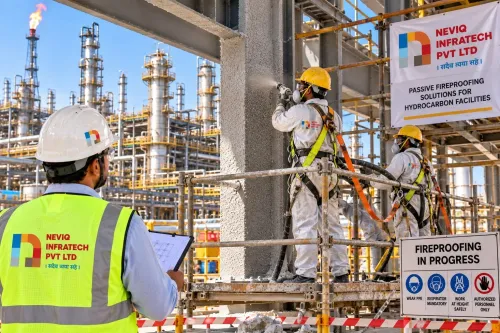
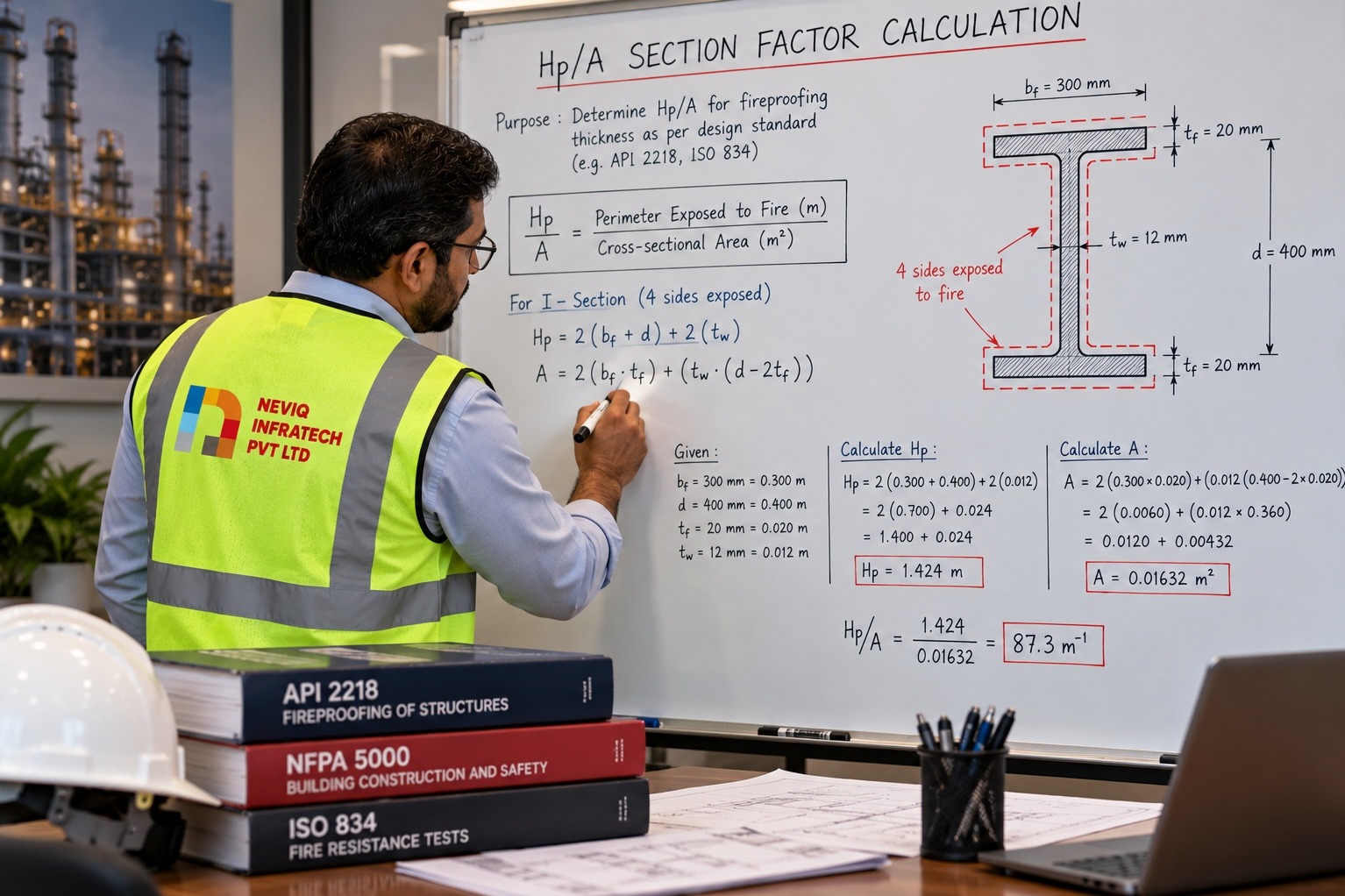
The Hp/A section factor is one of the most important design inputs for passive fireproofing of structural steel. It indicates how quickly a steel member is likely to heat up during a fire by comparing its heated perimeter (Hp) with its cross-sectional area (A).
Hp/A = Heated Perimeter of Steel ÷ Cross-Sectional Area of Steel
A high Hp/A value means that a larger steel surface is exposed to fire relative to the amount of steel mass. Such members heat up faster and normally require a thicker passive fire protection system to achieve the required fire-resistance rating. A lower Hp/A value indicates a heavier or less exposed member that heats more slowly and may require less protection, subject to the approved system design.
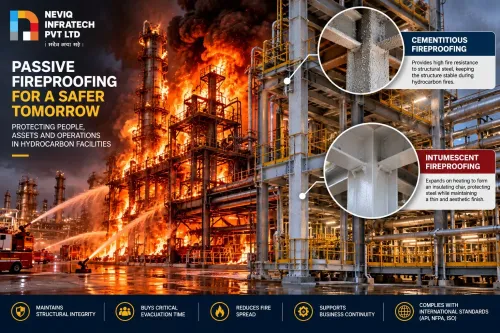
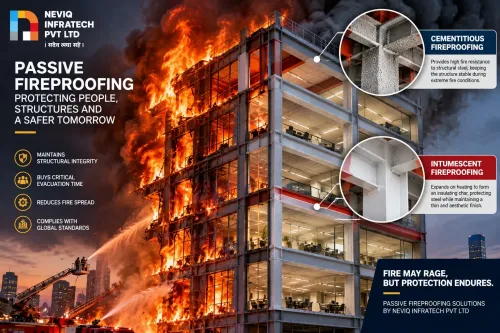
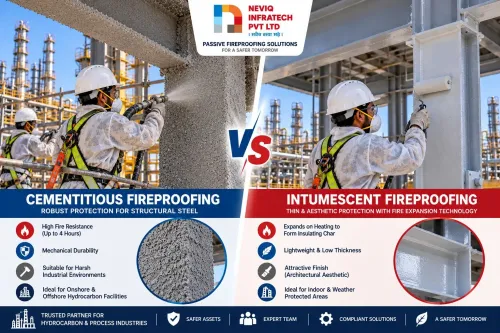
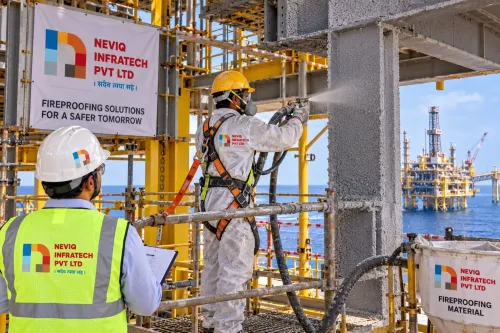
At NEVIQ INFRATECH, Hp/A assessment supports the correct selection and thickness specification of intumescent coatings, cementitious fireproofing sprays, and fire-rated board encasements for structural steel.
Parameters Needed to Calculate Hp/A Section Factor
The following information is required:
- Steel profile and dimensions: Beam, column, hollow section, channel, angle, truss member, or built-up section dimensions.
- Cross-sectional area of steel (A): Usually obtained from steel-section tables or calculated from the member geometry. If the member mass per metre is known, area can be derived using steel density.
- Heated perimeter (Hp): The length of the steel perimeter exposed to fire, measured in metres.
- Number of sides exposed to fire: A beam beneath a concrete slab may be exposed on three sides, while a freestanding column may be exposed on four sides.
- Type of fireproofing system: Profile-following systems, such as intumescent paint and sprayed protection, use a different perimeter from boxed board or encasement systems.
- Member position and adjoining construction: Surfaces built into walls, floors, or concrete may not be considered fire-exposed.
- Required fire resistance and critical steel temperature: These do not change the Hp/A calculation itself, but are essential for selecting the approved protection thickness.
How Hp/A Can Make or Break Passive Fireproofing Performance
Incorrect Hp/A assessment can lead to incorrect fireproofing thickness selection. If a high-Hp/A member is treated as though it has a lower section factor, the specified coating or encasement may be too thin. The steel can then reach its critical temperature earlier than expected, reducing load-carrying capacity and jeopardising the required fire rating.
Conversely, overstating Hp/A can result in unnecessary material use, additional dead load, higher cost, and avoidable project delays.
The same steel profile can produce different Hp/A values depending on whether the protection follows the steel contour or forms a box around it, and whether the member is exposed on three or four sides. Therefore, Hp/A must always be calculated to suit the actual steel geometry, fire exposure, and tested passive fire protection system.
For reliable performance, NEVIQ INFRATECH recommends that Hp/A values and protection thicknesses are verified against approved manufacturer data, project fire strategy requirements, and applicable codes before installation.
Keywords