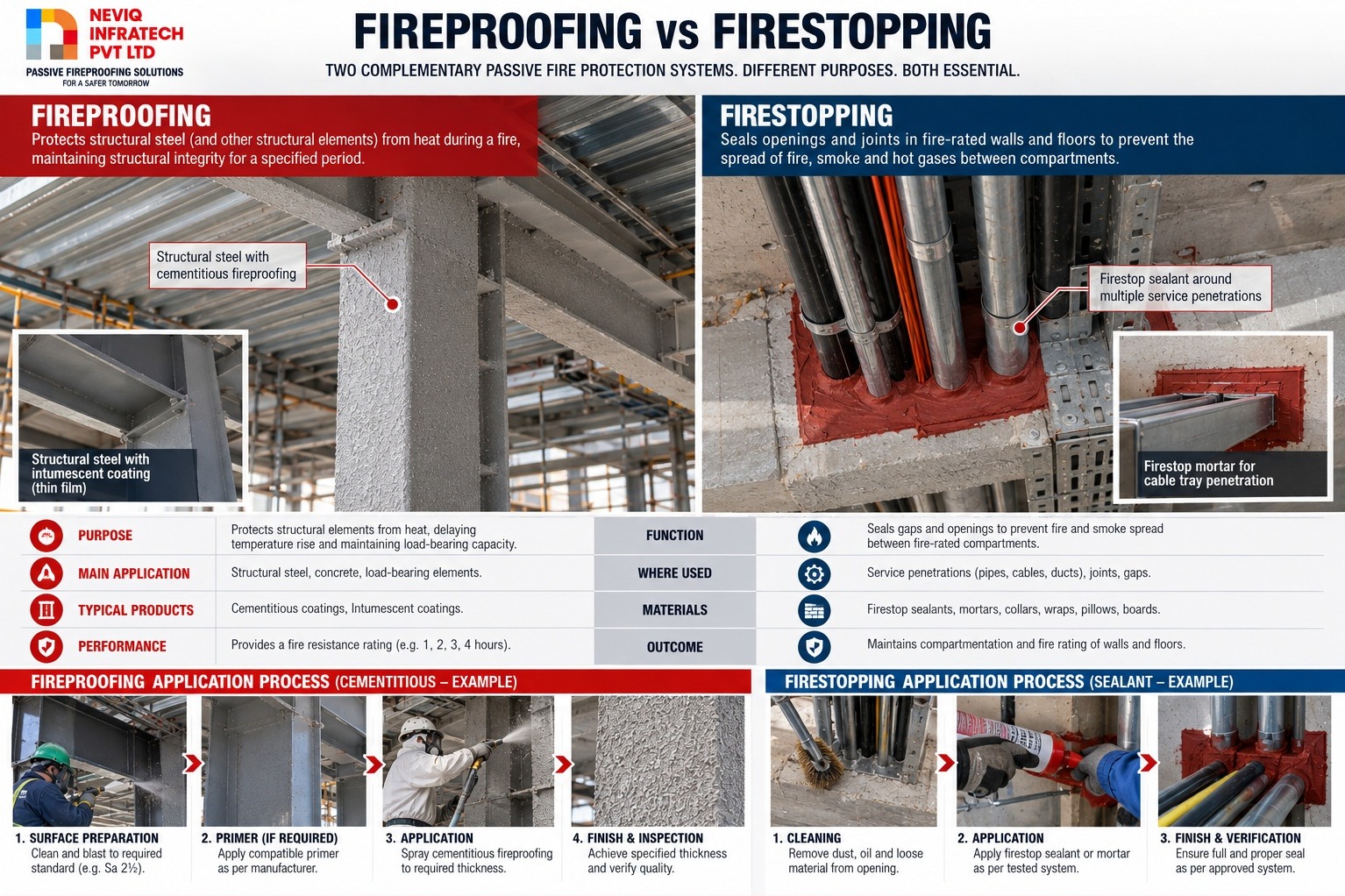
Fireproofing and firestopping are essential parts of a building’s passive fire protection strategy. Although the terms are often used interchangeably, they perform two distinct functions. Fireproofing protects structural elements such as steel beams, columns, trusses, and concrete from the heat of a fire. Firestopping seals openings and joints in fire-rated walls and floors so that fire, smoke, and toxic gases cannot spread from one compartment to another.
At NEVIQ INFRATECH, we help project teams understand and implement both systems as coordinated components of a safe, compliant building. The objective is not simply to apply a “fire-rated” product; it is to install the correct tested system for the specific structural member, wall, floor, joint, pipe, cable, or service penetration.
What is fireproofing?
Fireproofing is the protective treatment applied to structural building elements to delay heat transfer during a fire. Structural steel, for example, can lose strength rapidly at elevated temperatures. Proper fireproofing helps the member retain its load-bearing capacity for the required fire-resistance period, allowing occupants time to evacuate and supporting firefighting operations.
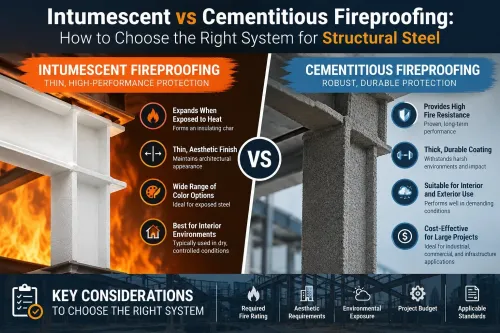
Common fireproofing methods include spray-applied fire-resistive materials, cementitious fireproofing, intumescent coatings. The right system depends on the fire rating, exposure conditions, architectural requirements, durability expectations, and governing project specification.
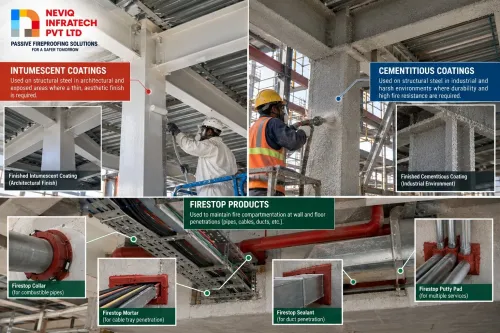
Spray-applied fire-resistive material, often called SFRM, is commonly used on concealed structural steel in commercial buildings, hospitals, offices, malls, warehouses, and high-rise developments. Usually gypsum- or cement-based, it is mixed with water on site and sprayed to the thickness required by the tested design. It may also be troweled for repairs or detailed areas. Products such as Promat PROMASPRAY-F5 and CAFCO 300 are examples of spray-applied systems used to protect structural steel and concrete.
Dense cementitious fireproofing is typically selected for demanding industrial environments such as refineries, power plants, petrochemical facilities, pipe racks, storage vessels, and offshore structures. These systems are mechanically spray-applied in layers and may be troweled for patching or finishing. Carboline Pyrocrete 241 is an example of cementitious fireproofing used where greater durability, impact resistance, or hydrocarbon-fire performance is required.
Intumescent fireproofing is a thin, paint-like coating often used where structural steel remains visible as an architectural feature. It is applied by spray, roller, or brush over properly prepared and primed steel. During a fire, the coating expands to create an insulating char layer around the steel. Products such as Carboline Thermo-Sorb 263 and Firefilm IV are examples of intumescent coatings for exposed structural steel. This approach is often preferred in airports, atriums, offices, retail spaces, and other projects where appearance matters.
What is firestopping?
Firestopping protects the openings, penetrations, and joints that would otherwise compromise a fire-rated wall or floor. A two-hour wall does not remain a two-hour barrier if cables, pipes, ducts, or construction joints pass through it without an appropriate firestop system.
Firestopping is used around electrical cables, cable trays, conduits, metallic pipes, plastic pipes, insulated pipes, busways, blank openings, HVAC penetrations, and service risers. It is also used at head-of-wall joints, floor-to-wall joints, façade perimeter gaps, and other locations where movement or construction sequencing creates gaps in a fire compartment.
For cable and metal-pipe penetrations, the opening may be packed with approved mineral wool and sealed with a compatible firestop sealant, mortar, putty, or modular cable-transit system. For combustible plastic pipes, an intumescent collar, wrap strip, or cast-in device expands during fire exposure to close the void left as the pipe softens or melts. Examples include 3M Fire Barrier Plastic Pipe Devices and Hilti CFS-C P firestop collars.
Fire-resistive joint systems are designed for locations where building movement is expected, such as wall-to-wall, floor-to-wall, slab-edge, and head-of-wall joints. These systems commonly use mineral wool backing with flexible firestop sealants or sprays. The installed system must accommodate the specified joint movement while maintaining fire and smoke containment.
Why the tested system matters
A firestop product alone does not provide a fire rating. The rating applies to the complete tested assembly: the rated wall or floor, the opening size, the penetrant type and size, insulation, annular space, backing material, sealant depth, support arrangement, and installation method.
For this reason, a generic instruction such as “seal all openings with fire-rated sealant” is not enough. Each condition should be matched to an approved, tested, or listed system that achieves the required fire rating and meets any smoke, acoustic, water-leakage, or movement requirements.
Recognized references include ASTM E814/UL 1479 for penetration firestop systems and ASTM E1966/UL 2079 for fire-resistive joint systems. UL also emphasizes that firestop systems are intended to restore the fire resistance of rated walls, partitions, and horizontal assemblies at penetrations and joints.
Fireproofing and firestopping by NEVIQ INFRATECH
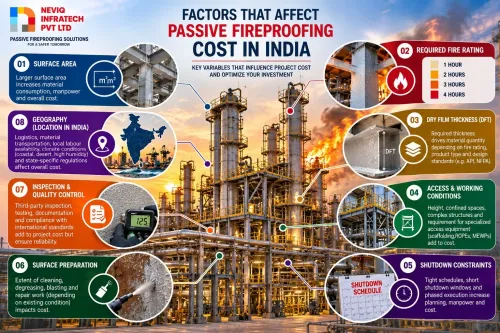
NEVIQ INFRATECH supports passive fire protection requirements across commercial, residential, industrial, institutional, and infrastructure projects. Our approach considers the required fire rating, substrate, service type, site conditions, system compatibility, installation quality, inspection, and project documentation.
Effective passive fire protection requires both fireproofing and firestopping. Fireproofing helps preserve structural stability. Firestopping protects compartmentation. Together, they help reduce the spread of fire and smoke, protect escape routes, and support a safer built environment.
Keywords