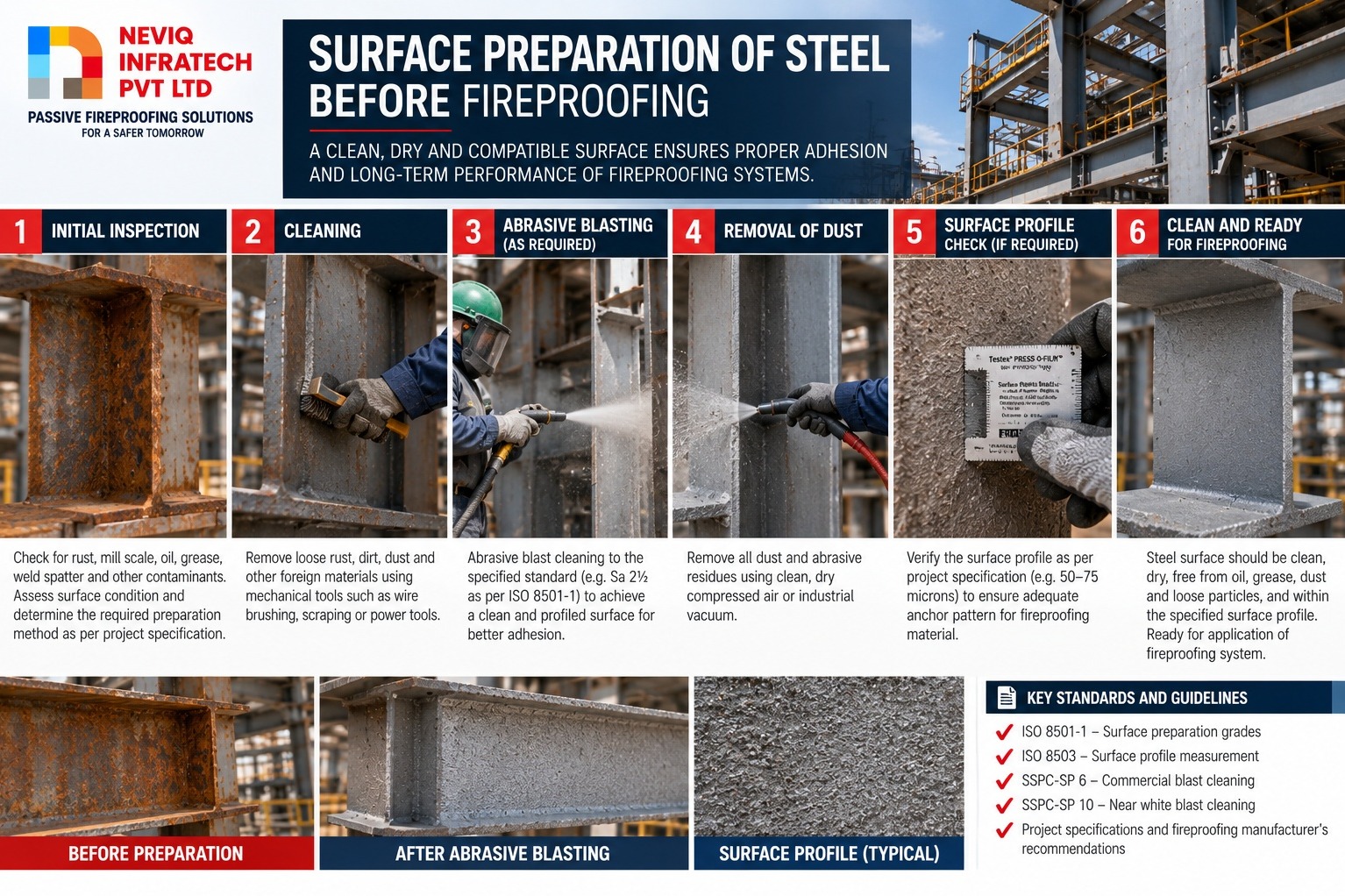
For carbon steel receiving a high-performance intumescent passive fire protection (PFP) coating, abrasive blast-cleaning to ISO 8501-1 Sa 2½ is the most common requirement. It is frequently paired in project specifications with SSPC-SP10/NACE No. 2 and is often called a “near-white” blast-cleaned finish.
However, Sa 2½ is not a universal requirement for every passive fireproofing system. The correct preparation depends on:
- The fireproofing material: thin-film intumescent, epoxy intumescent, cementitious spray fire-resistive material, board or concrete;
- The steel substrate: carbon steel, galvanized steel, previously coated steel or non-ferrous metal;
- The approved primer and complete coating system;
- The service environment, including internal, external, marine, chemical or hydrocarbon-fire exposure; and
- The exact tested and certified fire-protection design.
The governing rule is simple: follow the fireproofing manufacturer’s current data sheet, approved primer schedule and project fire-test specification. A preparation grade cannot be chosen in isolation.
Why surface preparation matters before PFP
Passive fireproofing works only if it remains in place for the required fire duration. Intumescent coatings swell into an insulating char during a fire, while cementitious materials create a protective insulating layer around the steel. In both cases, loss of adhesion can compromise the system before it has a chance to protect the structural member.
Surface preparation supports performance in three ways:
- Removes bond-breaking contaminants. Oil, grease, dust, mill scale, rust, soluble salts and condensation can prevent the primer or fireproofing from properly wetting and adhering to steel.
- Creates a controlled anchor profile. Blast cleaning removes corrosion products and creates microscopic surface roughness. This gives the coating system a mechanical “key.”
- Reduces under-film corrosion risk. Fireproofing should not be assumed to be corrosion protection. If corrosion starts beneath the PFP, it can progressively weaken adhesion and create hidden defects that are difficult to inspect.
The deeper issue, therefore, is not merely “How clean does the steel look?” It is whether the complete tested system—steel, preparation, primer, PFP and topcoat—will remain bonded and durable throughout its service life.
What does Sa 2½ mean?
ISO 8501-1 classifies the visible cleanliness of prepared steel. It is primarily a visual cleanliness standard; it does not, by itself, define surface profile, salt contamination limits, primer thickness or environmental conditions.
Sa 1--> Light blast cleaning; tightly adherent contamination may remain-->usually unsuitable for carbon-steel intumescent systems; may be relevant only to specific sweep-blast situations.
Sa 2--> Thorough blast cleaning; most mill scale, rust and old coating removed-->may be the minimum for certain epoxy intumescent or cementitious systems with approved primer.
Sa 2½--> Very thorough blast cleaning; only slight staining or traces may remain--> common default for high-performance intumescent PFP on carbon steel
Sa 3--> Visually clean steel with uniform metallic appearance--> only where specifically required; it is not automatically better value or necessary
When Sa 2½ is normally specified
Sa 2½ is widely used for thin-film and epoxy intumescent fireproofing where long-term adhesion and corrosion resistance are especially important.
For example:
- Sherwin-Williams’ FIRETEX Platinum epoxy intumescent data sheet requires steel to be blast-cleaned to Sa 2½, with an average surface profile of at least Rz 50 μm
- International Paint’s Chartek 7 application guidance states that steel is generally blast-cleaned to Sa 2½ or SSPC-SP10, with a 50–75 μm blast profile.
This does not mean every product under every condition needs the same treatment. It shows why Sa 2½ is a prudent and common starting point when the system is an epoxy or thin-film intumescent coating applied to new carbon steel.
When Sa 2 may be acceptable
Some systems allow Sa 2 as a minimum, especially when used with a qualified primer and where the manufacturer’s approval supports that configuration.
For instance, the Chartek 1709 epoxy intumescent technical data sheet states that carbon steel is typically applied over surfaces prepared to a minimum of Sa 2 / SSPC-SP6 and suitably primed, while identifying Sa 2½ / SSPC-SP10 as the preparation level for optimum performance.
This distinction matters commercially and technically:
- Sa 2 may be acceptable where the specific approved system permits it.
- Sa 2½ is often preferred where exposure is more severe, durability expectations are higher, or a coating manufacturer’s tested system requires it.
- Choosing Sa 2 merely to reduce blasting cost can be a false economy if it leads to reduced coating life, repairs or a non-compliant fire-protection system.
Cementitious fireproofing: do not assume the same grade
Cementitious PFP systems are not simply “thicker paint.” Their application methods, primers, metal lath requirements and bond mechanisms can differ substantially from intumescent coatings.
Some cementitious materials can be applied to unprimed steel; others require an approved compatible primer because of corrosion exposure, project specification or the desired fire-test assembly. Carboline’s Pyrocrete 241, for example, requires the substrate to be free of oil, grease, condensation and other contamination, and directs preparation before priming to the approved primer data sheet.
The practical lesson: do not copy the Sa 2½ requirement from an intumescent specification into a cementitious PFP specification without confirming the complete approved system.
Surface cleanliness alone is not enough
A specification stating only “Sa 2½” is incomplete. A reliable PFP specification should also address:
- Degreasing: Remove oil and grease before blast cleaning.
- Surface profile: Specify the required roughness range for the primer/PFP system.
- Dust removal: Vacuum or clean blast residue before coating.
- Soluble salts: Test where marine, offshore, industrial or contaminated exposure is possible.
- Edges, welds and sharp corners: Prepare them so the primer and PFP can achieve continuous coverage.
- Primer compatibility: Use only the primer, thickness and curing window approved with the PFP.
- Dew point and humidity: Apply only to a dry surface at the manufacturer’s required temperature and dew-point margin.
- Inspection hold points: Verify preparation before primer application, primer before PFP, and final PFP thickness after application.
A surface may visually appear to meet Sa 2½ yet still fail because its profile is wrong, moisture has condensed, dust remains, salts are present, or an unapproved primer was used.
A practical decision framework
Before specifying or accepting surface preparation for PFP, ask these questions in sequence:
- What PFP product and tested fire-resistance design are being used?
- What substrate is present—carbon steel, galvanized steel, coated steel or concrete?
- Is a primer required for corrosion protection or system approval?
- What preparation grade and profile does the current manufacturer data sheet require?
- Is the structure internal, external, marine, industrial or hydrocarbon-fire exposed?
- Are all specified components approved together: primer, PFP, mesh, topcoat and repair method?
- Has the prepared surface been inspected and released before coating starts?
Common mistakes to avoid
Mistake: Treating Sa 2½ as a complete specification: Sa 2½ addresses visible cleanliness, not profile, salt level, primer compatibility or coating thickness.
Mistake: Using an unapproved primer: A primer can appear suitable for corrosion protection but still be incompatible with the fireproofing system or outside the tested certification.
Mistake: Assuming PFP eliminates corrosion concerns: Passive fireproofing is designed to delay steel heating in a fire; it is not automatically a corrosion-control system.
Mistake: Applying over damp or contaminated steel: Galvanized surfaces usually need degreasing and controlled sweep blasting or abrasion—not aggressive blasting that strips zinc.
Final recommendation
For most carbon-steel intumescent PFP applications, specify ISO 8501-1 Sa 2½ abrasive blast cleaning, together with the manufacturer’s required surface profile, approved primer, environmental controls and inspection criteria.
For epoxy intumescent, cementitious, galvanized, repair and previously coated applications, do not apply a one-size-fits-all rule. The minimum acceptable preparation may differ, and the approved system documentation must govern.
The best specification language is therefore:
'Prepare steel surfaces in accordance with the passive fire protection manufacturer’s current approved system specification. For carbon steel, abrasive blast-clean to the stated grade—commonly ISO 8501-1 Sa 2½ for intumescent systems—achieve the specified surface profile, remove dust and contamination, and apply only approved primers and PFP materials within their stated environmental and overcoating limits.'
Keywords